AI Automations
Voice AI ReceptionistCustom AI AssistantsLead Nurturing & SMS Text-BackReview AutomationAI Appointment SchedulingNo-Show Recovery AutomationClient Case Studies
Turf Titans Lawncare Local SEO PlaybookTurf Titans Lawncare
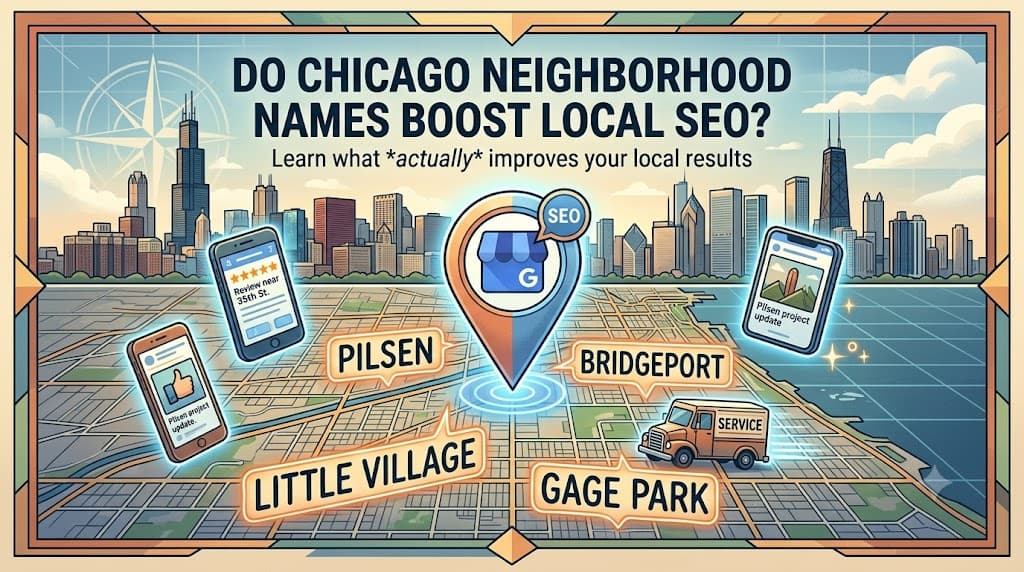
Stuffing every Chicago neighborhood into your Google Business Profile won’t expand your ranking radius—proximity and authentic local signals do. That’s the part most businesses overlook when they try to “hack” local SEO in Chicago neighborhoods.
In a city where Pilsen, Little Village, Bridgeport, Gage Park, and Garfield Ridge sit tightly together, your visibility can change block by block. If you run a service business here, the way you reference neighborhoods on your site and in your GBP matters—but not for the reason many expect.
Bottom line up front: using neighborhood terms can improve relevance inside or near those areas, but they won’t override proximity. The winning approach is one GBP per real, staffed address and a handful of high-impact neighborhood pages supported by unique content, photos, and reviews that mention the area. If you want help, see how our Chicago program works at Local SEO services → (/services/local-seo-chicago).
What does Google consider a Chicago neighborhood for local SEO?
In practice, Google doesn’t use an official City Hall boundary to decide who’s “in” Pilsen or Bridgeport. It relies on your precise business coordinates, your stated address, how searchers phrase queries (like “plumber near 18th Street Pilsen”), and a web of local signals—reviews, content, and citations—that hint at where you actually work and are known.
For map results, the ranking trinity is proximity, relevance, and prominence. Proximity is physics: where you are when people search and where your business pin sits. Relevance is how well your profile and pages match the query (e.g., “roof repair in Gage Park”). Prominence is authority: consistent NAP, reviews, photos, local press, and brand signals. Neighborhood names mostly influence relevance and, indirectly, prominence—not proximity.
Do neighborhood keywords boost local SEO in Chicago neighborhoods beyond your immediate area?
They help you show up more often inside the neighborhoods you truly serve, especially for longer-tail searches that include “near me,” street names, or landmarks. But they won’t magically pull your pin five miles away. A Bridgeport electrician doesn’t outrank a Garfield Ridge electrician for “electrician near Midway” just by listing “Garfield Ridge” on a page.
Where they do shine: edges and overlaps. If your office is in McKinley Park and you consistently earn reviews and publish project write-ups from Pilsen and Bridgeport, you can capture more visibility along those borders—particularly for non-brand, non-hardcore “near me” queries. Think of neighborhood keywords as a relevance amplifier, not a radius expander.
How should you reference Pilsen, Little Village, and Bridgeport on your site?
Be specific and human. Generic “We serve all Chicago neighborhoods” tells Google nothing. Instead:
- •Work in natural mentions: “Emergency lockout on 18th Street in Pilsen,” or “AC replacement near 26th Street in Little Village.”
- •Show real work: short case studies with 2–4 photos from the job (faces optional), a one-paragraph challenge/solution, and a quick testimonial.
- •Add local context that only someone who works there would note: parking tips around 35th Street on game days in Bridgeport, or narrow gangways that require smaller equipment.
- •If your team routinely serves Spanish-speaking customers in Little Village, reflect that authentically—service notes, bilingual FAQs, or a short Spanish summary. Authenticity beats lists of keywords every time.
Anchor these snippets on a few dedicated pages, not scattered across a hundred thin posts. And keep your main service pages clean, then cross-link thoughtfully to a small set of neighborhood pages when relevant. For the strategy and templates we use, see Local SEO services in Chicago → (/services/local-seo-chicago).
Should you create separate Google Business Profiles for each neighborhood?
No—unless you actually operate staffed locations in those neighborhoods. One Google Business Profile per real, staffed address is the rule. Virtual offices, coworking mailboxes, or suite rentals without on-site staff risk suspension and can crater your visibility citywide.
If you have multiple legitimate Chicago locations (say, an office in the Loop and a shop in Brighton Park), each can have its own GBP—with unique hours, photos, and local content tied to that address. But don’t spin up extra profiles for “coverage.” Use one strong profile and let neighborhood-focused content and reviews do the relevance work.
What’s the right way to set service areas for a Chicago-based business?
For service-area businesses (no public storefront), set service areas to reflect where you actually go. Keep it lean:
- •Choose the city (Chicago) and a handful of nearby suburbs or ZIPs you truly cover often. Don’t cram in 20 neighborhoods.
- •Remember: service areas don’t extend map-pack radius. They clarify coverage on your profile and can help relevance in text-based results.
- •Match your service areas to what’s on your website and what customers say in reviews. Alignment across GBP, site content, and citations quiets doubt.
- •Update after a move or if you exit a far-flung suburb. Outdated coverage confuses users and weakens trust.
Treat service areas like your operations map, not your ranking lever. Your pin still ranks where it physically exists.
Which on-page signals improve local SEO in Chicago neighborhoods like Gage Park or Garfield Ridge?
If you want to be chosen for “plumber Gage Park” or “roof repair Garfield Ridge,” build pages that feel unmistakably of those places:
- •Titles and headers that pair the service with the neighborhood: “Water Heater Repair — Gage Park.”
- •Original photos from jobs in the area, with descriptive filenames and alt text (“furnace-installation-gage-park-basement.jpg”).
- •Short job snapshots: “Replaced a 40-gallon unit near 55th & Kedzie in Gage Park—tight utility closet, solved with compact venting.”
- •Neighborhood FAQs: common materials, building quirks, seasonality, and access constraints specific to the blocks you serve.
- •Driving/transit cues for credibility: “10 minutes south of Archer Ave via Pulaski,” or “near Midway, east of Central.”
- •LocalBusiness schema with precise NAP and a sane areaServed list. Keep it honest and consistent with GBP.
- •Internal links from your Chicago hub page to these neighborhood pages and back, using natural anchor text.
Do a few of these well and keep them fresh. Thin pages that just swap “Gage Park” for “Garfield Ridge” everywhere don’t help—and can dilute your whole site.
If this sounds like a lot to plan and produce, Base64 Marketing builds, writes, and maintains high-impact neighborhood pages and review strategies for Chicago businesses. See our Local SEO program → Same-week kickoff. No long-term contracts. Clear reporting.
Can reviews that mention a neighborhood boost your local rankings?
Yes—when they happen naturally. Reviews are a prominence signal; when they also include neighborhood names (“Fantastic install in our Gage Park bungalow”), they add a touch of relevance. You can’t script customers, but you can nudge context:
- •After the job, ask, “If it helps others nearby—feel free to mention your neighborhood in your review.”
- •Use short, memorable links or QR codes on job cards so leaving a review is effortless.
- •Spotlight a few neighborhood-tagged reviews on the matching neighborhood page to reinforce the loop.
Avoid keyword-stuffed review “templates” or incentives. Authentic, specific praise beats formulaic phrases every time.
When is a dedicated neighborhood landing page worth building for local SEO in Chicago neighborhoods?
Build one when you can make it real:
- •You already serve that neighborhood often, or it borders your pin.
- •You have photos, job notes, and at least a couple of reviews from customers there.
- •You can write something unique about the housing stock, common issues, or access quirks (alley widths, parking restrictions, seasonal demand spikes).
- •You’ll keep it updated once or twice a year.
What to include:
- •A clear service overview tailored to the neighborhood.
- •2–3 job snapshots with captions, plus a small gallery.
- •A handful of FAQs unique to the area.
- •A request-for-review blurb that subtly prompts neighbors to name their area.
- •Internal links from your Chicago hub and relevant service pages.
How many? Start with three to five: the neighborhoods adjacent to your location and the one or two where you close the most jobs. Track impressions, calls, and directions queries by neighborhood terms in GBP Performance and Search Console. Expand only when the first set proves its value.
Local takeaway
Neighborhood names won’t bulldoze proximity in Chicago’s dense map packs—but they absolutely help you win inside (and just beyond) the areas you genuinely work. The durable play is simple and disciplined: one GBP per real, staffed address and a small set of neighborhood pages powered by real photos, short case studies, and reviews that mention the area. That combination creates the authentic local signals Google keeps rewarding.
Ready to align your visibility with the neighborhoods you actually serve? Get a free local SEO audit for Chicago businesses → (/locations/chicago)
FAQs
Common questions
Can I rank in Wicker Park if my office is in Logan Square?▾
Sometimes—especially for broader queries and if you’re near the border and have strong reviews and local signals—but proximity still sets the ceiling.
Are Chicago community areas different from neighborhoods for SEO?▾
Yes. Community areas are formal; neighborhoods are informal. Google cares most about your exact pin location and how people refer to places in searches.
Is it okay to add a virtual address or mailbox to get a neighborhood pin?▾
No. One Google Business Profile per real, staffed address. Virtual offices and mailboxes risk suspension.
How many neighborhood pages should I create?▾
Build 3–5 high-impact pages tied to real work you’ve done there—avoid churning out dozens of thin doorway pages.
Do service area settings change where I rank on the map?▾
They don’t expand your radius. They clarify coverage to users and can aid relevance, but proximity still drives map rankings.
What counts as convincing local proof on a neighborhood page?▾
Original photos from jobs, short case studies, directions from known streets or transit stops, and reviews that mention the neighborhood by name.
Get Started
Get the audit: we'll show your top 10 ranking + lead leaks.
We'll show your top 10 ranking + lead leaks, and exactly what to fix first.
Or call us: (312) 646-0326